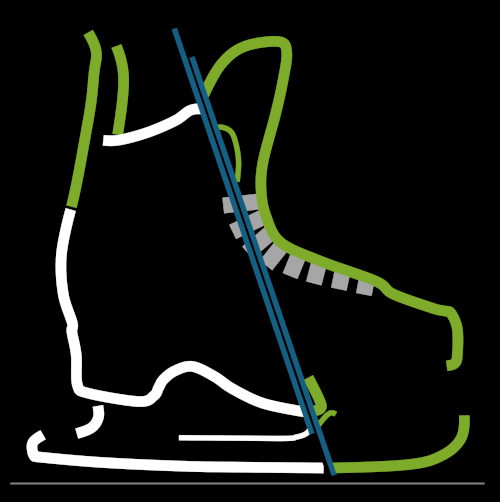
Profile drift is unavoidable. Every sharpening removes steel from a hockey skate blade, and over time this gradually alters how the blade sits and moves on the ice.
What can be controlled is how consistent those changes are. Profile drift is minimized by professional and experienced skate sharpening technicians, such as Rich@TheRink, particularly when precise sharpening tools and well-maintained machines are used.
If your skates feel off after sharpening — balance, stability, turning, or stopping — the best course of action is to speak directly to the person who sharpened your blades.
The profile (or rocker) of a hockey blade is the front-to-back curve of the runner. It determines how easily the blade turns, how stable it feels at speed, and where the skater’s weight naturally sits.
Profile drift is the gradual change of that curve over time due to steel removal from repeated sharpening.
Sharpening restores edge sharpness and hollow depth, but it also removes steel. If steel is removed unevenly along the blade, the rocker can slowly change.
An experienced sharpener reduces this risk by maintaining consistency and monitoring blade wear.
Flattening increases blade contact with the ice.
Some hockey players prefer mild flattening, but unintended changes can feel unbalanced.
Rounding shortens the contact patch.
Blades that start with a very flat profile, such as very cheap figure skates and ice hockey goalie skates, may be manufactured with, or develop a rocker inversion, which simply put is where a hollow exists on the profile, and part of the blade is unable to reach the ice.
Profile drift can move the balance point forward or backward.
Professional sharpening focuses on:
Using the same experienced technician, such as Rich @ TheRink, improves consistency over time.
A few skate maintenance shops in the UK offer blade reprofiling to bring the profile back to 'true', or even to change the blade profile to one of many different styles (single radius, multi-radius, zoned, etc.)
Current;y Rich@TheRink does not provide this service directly, but depending on requirements may be able to facilitate sending the blades off to a specialist.
The metal runner attached to the boot that contacts the ice. It includes the edges, hollow, and rocker (profile).
The vertical distance from the ice to the bottom of the blade holder or toe pick area. Blade height gradually decreases as steel is removed through sharpening.
The point on the blade where the skater feels naturally centred and stable over the ice. Changes in blade profile can move this point forward or backward.
The portion of the blade that is touching the ice at any given moment. A longer contact patch feels more stable; a shorter one feels more agile.
A controlled process that reshapes the blade’s rocker to restore or adjust its intended profile after drift or wear.
The two sharp sides of the blade created by sharpening. One is the inside edge and the other is the outside edge.
A measure of whether both edges are the same height. Uneven edges can cause pulling, slipping, or imbalance.
A form of profile drift where the blade’s rocker becomes less curved, increasing the length of blade contacting the ice.
The concave groove ground into the bottom of the blade during sharpening. It determines how sharp or grippy the edges feel.
The front-to-back curve of the blade. It controls how the blade balances, turns, spins, and transitions on the ice.
The gradual change of a blade’s rocker shape over time due to repeated sharpening and steel removal.
A form of profile drift where the blade becomes more curved, shortening the contact patch and making the blade feel more “rocky.”
Another term for the blade itself, particularly the steel portion that is sharpened.
The area of the blade where spins feel most stable and controlled. Profile drift can cause this spot to move or shrink.
The material that is ground away during sharpening. Steel removal is unavoidable and is the root cause of profile drift over time.
A trained person who sharpens skates and may also assess blade alignment, edge level, and profile condition.
The rotating abrasive wheel on a sharpening machine that removes steel and forms the hollow.