When you leave your skates for sharpening, you will often be asked “what depth [of hollow, or profile] would you like?”
Please note that currently Rich@TheRink does not provide flat-bottom grinding.
Most new/beginner skaters straight out of hire skates will use 5/8ths for a short period before trying other depths, while getting used to new skates
Why? Hire skates are typically sharpened to 3/4 or 5/8ths radius of hollow. These is a fairly standard beginner sharpening.
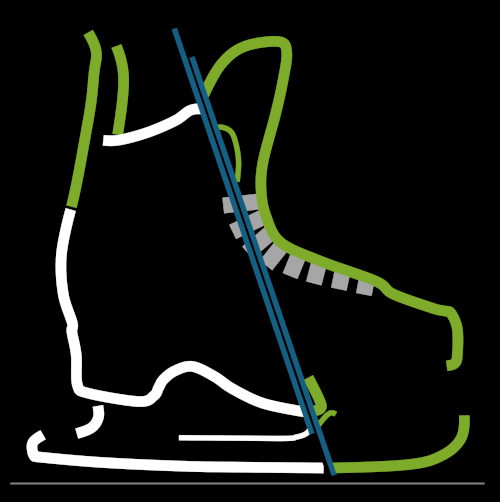
When you buy your own pair of reasonable quality skates, the profile of the blade (how it curves from toe to heel) will be curvier, which makes the skate feel sharper for any given radius of hollow. On top of this, you'll have to get used to the feel and control of the boot.
Going straight for a more aggressive radius of hollow risks confusing and setting the skater back further than necessary. Our recommendation is to only change one thing at a time; first change the boot and use the radius of hollow that you're used to; get a feel for the new boot and then (and only then) consider whether a change in hollow is required. Sometimes it's obvious straight away, and Rich@TheRink will resharpen skates to a different depth free of charge if dropping back within 2 weeks of sharpening.
Ice skate edges are formed by grinding out a (typically) circular hollow in the middle of the blade. The “depth”, “depth profile", "depth of hollow" or "radius of hollow" refers principally to the radius of the circle, in inches or millimeters. 5/8ths is therefore “5/8ths of an inch radius”.
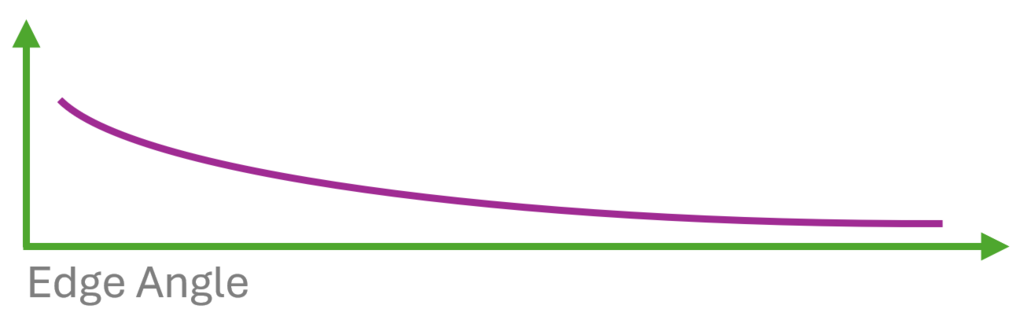
As you decrease the radius of the grind, you increase the depth of the hollow, which makes the skate edges sharper. The skates become stickier on the ice; gliding becomes harder, but turns, spins and jumps typically become easier.
Very new figure skaters will start at 5/8ths, but as they progress they may go down to 1/2 inch, then 7/16ths, sometimes even as far as 3/8ths but this depends on many factors including the type of blade you have; the key is to find your preferred radius using the radius check tool on https://skaters.therink.uk.
Hockey skaters are often told "1/2 is the best for hockey"; Rich@TheRink doesn't believe that is true at all. Many hockey skaters come to Rich or use the radius check tool on https://skaters.therink.uk to seek independent advice, and some end up on 3/4" (very shallow) in order to preserve speed and energy.
Use the radius check tool on https://skaters.therink.uk as a starting point.
Ask your skate technician, and they will be able to give you some general advice – if you’re visiting a technician not based in a specific ice rink, or a different ice rink to where you normally skate, bear in mind that their advice will only be general, and you may prefer to go shallower/deeper from their advice. You may also end up going shallower/deeper depending on how confident you feel on your skates.
Our recommendation on depth is as follows, from shallower to deeper. While you can pick increments between these, we do not feel it’s worth it (why? see our ‘for the geeks’ section below, or ask us about our Visualizer tools).
It’s worth noting that figure skates blades are generally 1mm wider than hockey skates, and therefore for any given depth are sharper than hockey blades (i.e. if you grind a pair of figures, and a pair of hockey skates to 5/8ths, the figures will feel sharper). Why? See our ‘for the geeks’ section below, or ask us about our Visualizer tools.
No. Firstly, on the assumption that it’s appropriate to grind the skates you have deeper, the blades do not wear uniformally as you skate. If you were to grind the skates to 1/2 inch, after some time they will not be “5/8ths”. They will simply be a blunt 1/2 inch grind, as what makes the skates “blunt” are rounded edges.
In fact, counterintuitively, getting a deeper grind may result in your needing to have them re-sharpened more regularly, as the rounding on sharper blades happens faster.
Leaving your skates between sharpening for too long will result in a larger sharpness difference after you’ve sharpened them, meaning you’ll need to re-adjust to skating on sharp blades.
Leaving your skates between sharpening for too long may also result in deep rust – as the grinding process will remove any rust spots before they become a real problem…
How often you get your skates sharpened will depend on many factors too, but generally getting the ground deeper will not extend that time.
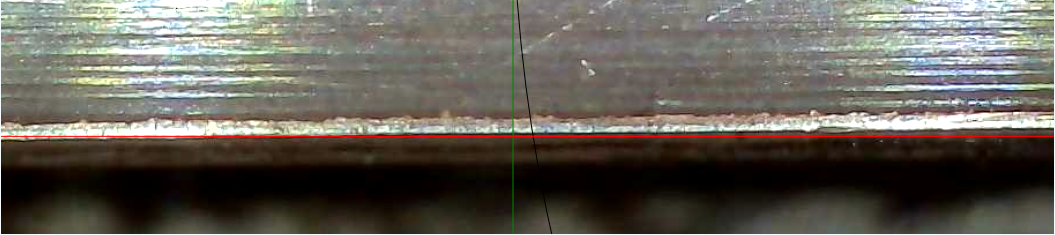
Blunt skates are caused by rounded edges – instead of a nice, crisp, sharp angle, the rounding will allow the skate to slip sideways.
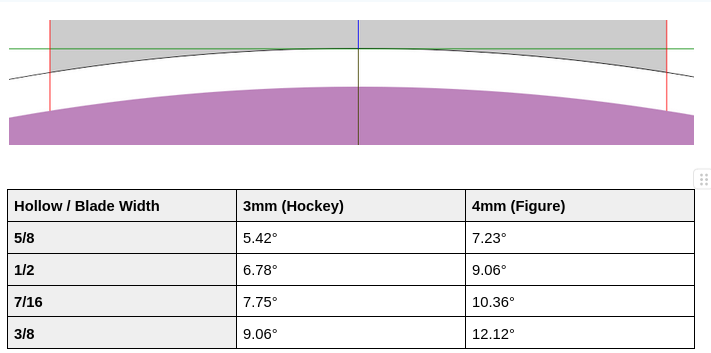
See the table below to convert the hollow radius, along with the width of the blade, to the angle of the edge against the ice. This doesn’t really provide any practical purpose, other than to illustrate that as you get deeper, you typically need smaller adjustments of radius to maintain a consistent difference between the angle. This is the primary reason we don’t normally use 9/16ths – the difference between that and 5/8ths is quite small, though some people still ask for it, and we’re happy to oblige.