Re-edgers are a common tool in ice skating, particularly among hockey players and recreational skaters. When used correctly and sparingly, they can improve on-ice feel between professional sharpenings. When overused or misunderstood, they can shorten blade life and negatively affect skating performance.
This page explains what re-edgers actually do, how to use them properly, and—just as importantly—what they should not be used for.
A re-edger is a handheld tool designed to remove burrs and surface damage from the edges of a skate blade. Most re-edgers use either carbide inserts, ceramic stones, or hardened steel to lightly abrade the blade edges.
They are not a substitute for a full sharpening and are not capable of restoring a correctly profiled hollow or blade geometry.
Think of a re-edger as maintenance, not sharpening.
This is the most important point to understand.
A re-edger:
However, this comes at a cost.
A re-edger:
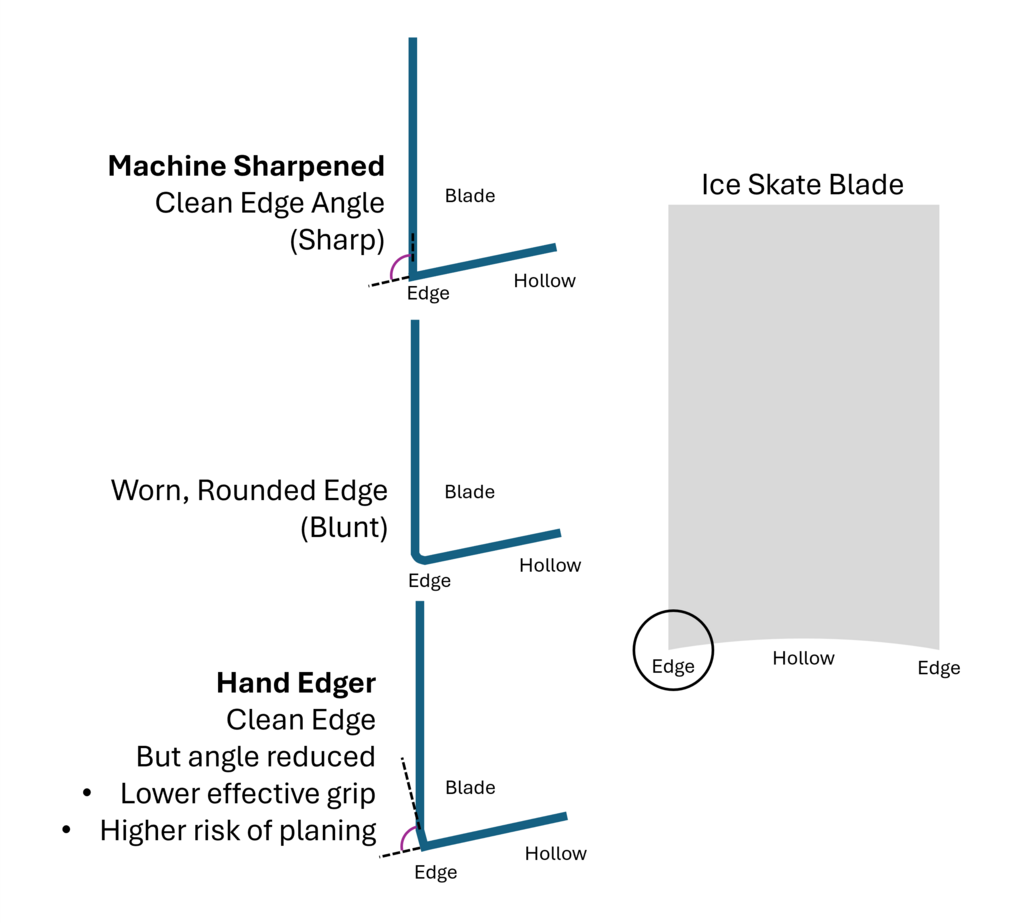
In simple terms:
You get a cleaner, sharper-feeling edge, but you lose the precise edge geometry created by a professional sharpening.
This is why skates that are frequently re-edged often feel “sharp but skiddy” or lack consistent grip in turns.
Re-edgers are best used:
Avoid using a re-edger:
If your skates no longer hold an edge in turns or stops, a re-edger will not solve the underlying problem—and may make it worse.
If you choose to use a re-edger, technique matters.
General guidelines:
Do not:
Aggressive or repeated use accelerates edge angle loss and blade wear.
Frequent re-edging:
Because re-edgers remove material from the edges only, they change the blade in a different way than a sharpening machine, which re-establishes symmetry and hollow across the full width.
Re-edgers can be useful tools when used with restraint and understanding. They provide a cleaner, sharper-feeling edge by removing damage, but they do so at the expense of edge angle and blade geometry.
Used occasionally and carefully, they can extend a sharpening. Used frequently or aggressively, they degrade performance and shorten blade life.
If in doubt, a proper sharpening is always the better solution.