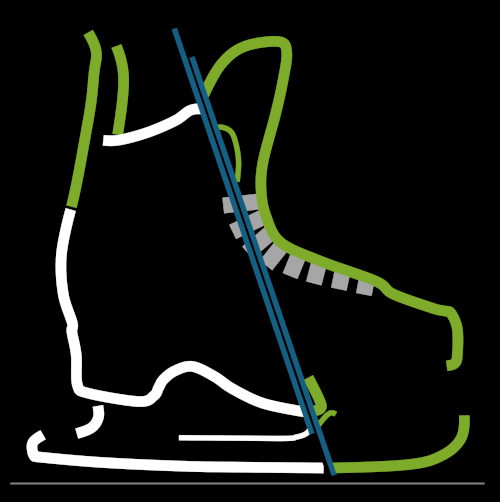
Profile drift is unavoidable. Every sharpening removes steel from a figure skate blade, and over time this gradually changes the blade’s shape.
What can be controlled is how much the blade changes and how consistently it behaves from one sharpening to the next. Profile drift is minimized by professional and experienced skate sharpening technicians, such as Rich@TheRink, especially when precise sharpening tools and well-maintained machines are used.
If anything feels off after sharpening — balance, spins, stability, or toe-pick behaviour — the best course of action is always to speak directly to the person who sharpened your blades. They are best placed to assess what has changed and correct it properly.
The profile (also called the rocker) of a figure skate blade is the gentle front-to-back curve of the runner. This curve determines how the blade contacts the ice, where the skater feels balanced, and where spins and turns feel most stable.
Profile drift refers to the gradual change of that curve over time as steel is removed during sharpening.
Sharpening restores edge sharpness and the hollow, but it also removes steel from the bottom of the blade. If steel removal is not perfectly even along the length of the runner — even by very small amounts — the rocker can slowly change.
An experienced sharpener cannot prevent steel wear, but they can:
Flattening occurs when the blade’s rocker becomes less curved, increasing the amount of blade contacting the ice at once.
Flattening is not always negative, but unintended flattening can feel very different — especially if one skate changes more than the other.
Rounding is when the blade becomes more curved, shortening the contact patch.
Figure skaters often feel:
Profile drift can move or shrink these areas.
If these changes appear after sharpening, do not assume it is purely a technique issue.
As figure skate blades are sharpened repeatedly, the blade becomes lower. This reduces the distance between the ice and the toe pick, even though the pick itself has not changed.
If toe-pick behaviour feels different after sharpening, speak to your sharpener so they can assess whether this is normal wear or something that needs correction.
Experienced sharpening technicians minimise drift through:
Staying with one experienced sharpener, such as Rich @ TheRink, improves long-term consistency.
The metal runner attached to the boot that contacts the ice. It includes the edges, hollow, and rocker (profile).
The vertical distance from the ice to the bottom of the blade holder or toe pick area. Blade height gradually decreases as steel is removed through sharpening.
The point on the blade where the skater feels naturally centred and stable over the ice. Changes in blade profile can move this point forward or backward.
The portion of the blade that is touching the ice at any given moment. A longer contact patch feels more stable; a shorter one feels more agile.
A controlled process that reshapes the blade’s rocker to restore or adjust its intended profile after drift or wear.
The two sharp sides of the blade created by sharpening. One is the inside edge and the other is the outside edge.
A measure of whether both edges are the same height. Uneven edges can cause pulling, slipping, or imbalance.
A form of profile drift where the blade’s rocker becomes less curved, increasing the length of blade contacting the ice.
The concave groove ground into the bottom of the blade during sharpening. It determines how sharp or grippy the edges feel.
The moment when the toe pick makes contact with the ice. Changes in blade height or profile can cause earlier or later engagement.
The front-to-back curve of the blade. It controls how the blade balances, turns, spins, and transitions on the ice.
The gradual change of a blade’s rocker shape over time due to repeated sharpening and steel removal.
A form of profile drift where the blade becomes more curved, shortening the contact patch and making the blade feel more “rocky.”
Another term for the blade itself, particularly the steel portion that is sharpened.
The area of the blade where spins feel most stable and controlled. Profile drift can cause this spot to move or shrink.
The material that is ground away during sharpening. Steel removal is unavoidable and is the root cause of profile drift over time.
The serrated teeth at the front of a figure skating blade used for jumps, steps, and stops.
The distance between the toe pick and the ice. As blade height decreases, clearance is reduced, causing earlier pick engagement.
A trained person who sharpens skates and may also assess blade alignment, edge level, and profile condition.
The rotating abrasive wheel on a sharpening machine that removes steel and forms the hollow.